Energy and water: MVR, membranes and smarter CIP in juice plants
The evaporator and cleaning weigh heavily on a juice plant's bills. The technologies that reduce steam, electricity and water use.
In a citrus concentrate plant, evaporation is by far the largest user of steam. Cleaning in place (CIP) accounts for a large share of water and chemicals. With rising energy costs and water stress in Morocco, both have become strategic.
Mechanical vapour recompression (MVR)
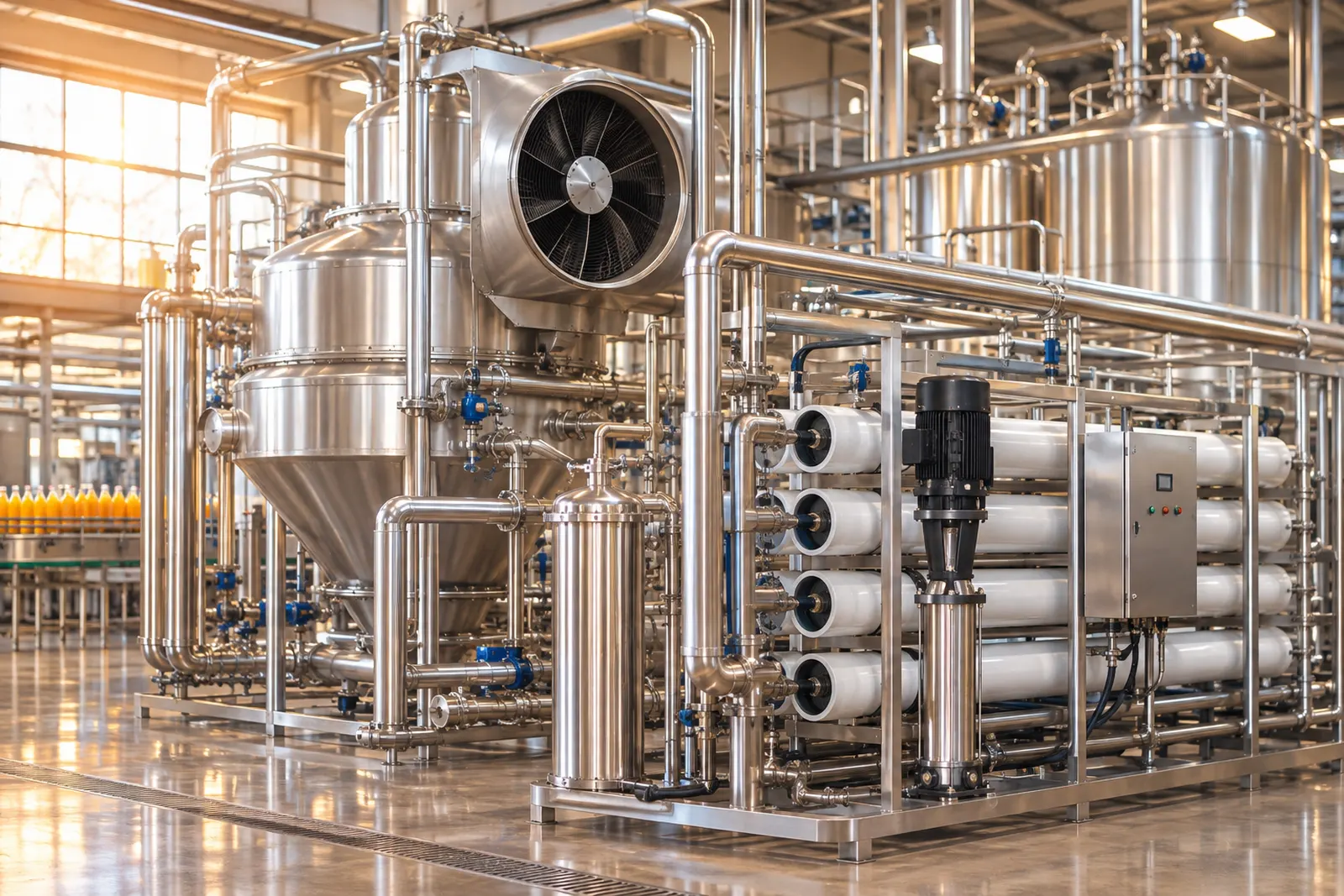
In a conventional evaporator, the vapour produced by boiling the juice is largely lost at the condenser, or reused from one effect to the next. With MVR, an electrically driven fan or compressor recompresses that vapour so it can be reused as the heating medium. Live steam consumption drops sharply, replaced by electricity.
Whether it pays depends on the ratio between electricity and steam prices. As solar and wind power grow, MVR also becomes a decarbonisation lever.
Pre-concentrating by reverse osmosis
Reverse osmosis removes part of the water from the juice at ambient temperature, through a membrane, before the evaporator. It cannot reach the Brix that evaporation does, but every tonne of water removed by membrane is a tonne less to evaporate. The energy saving is significant, and the existing evaporator gains capacity.
Recover heat everywhere
- Preheat incoming juice with juice leaving the pasteuriser
- Recover hot condensate for boiler feed or CIP
- Insulate hot pipes and tanks, often overlooked
- Meter consumption by area, not only for the whole plant
CIP that uses less
Conductivity and turbidity sensors show exactly when a rinse phase is finished, instead of applying fixed 'safe' times. Recovering cleaning solutions and reusing the final rinse water for the next pre-rinse cut volumes sharply. All of this must be validated: optimised cleaning still has to be effective cleaning.
Our approach
- Consumption audit and mass and energy balance
- Ranking actions by saving and cost
- Techno-economic study of MVR and membrane options
- Validating new CIP cycles in the HACCP plan
- Setting up indicators per tonne of fruit processed