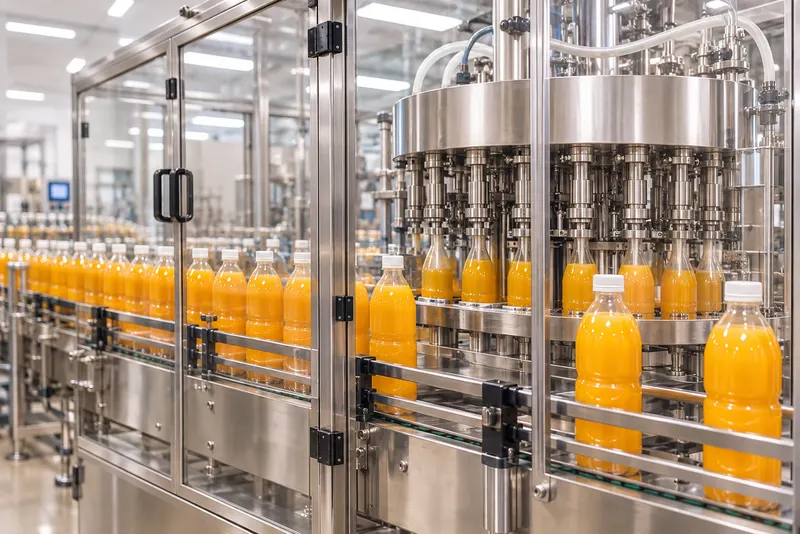
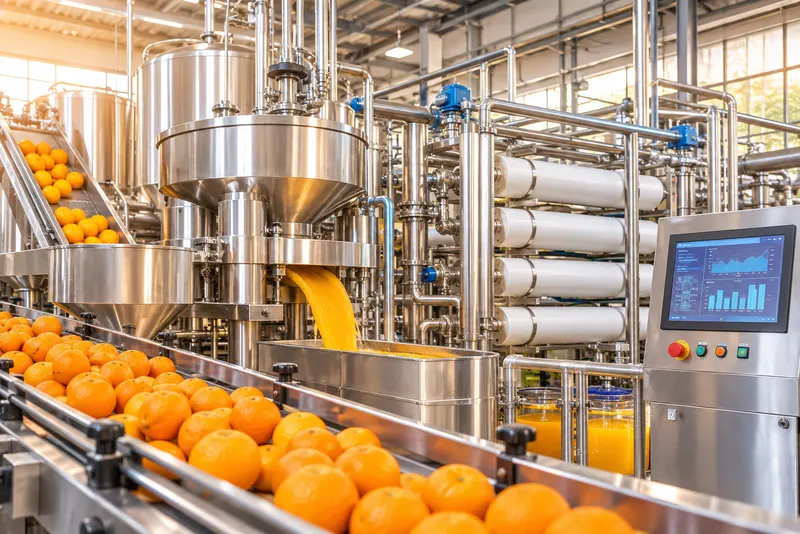
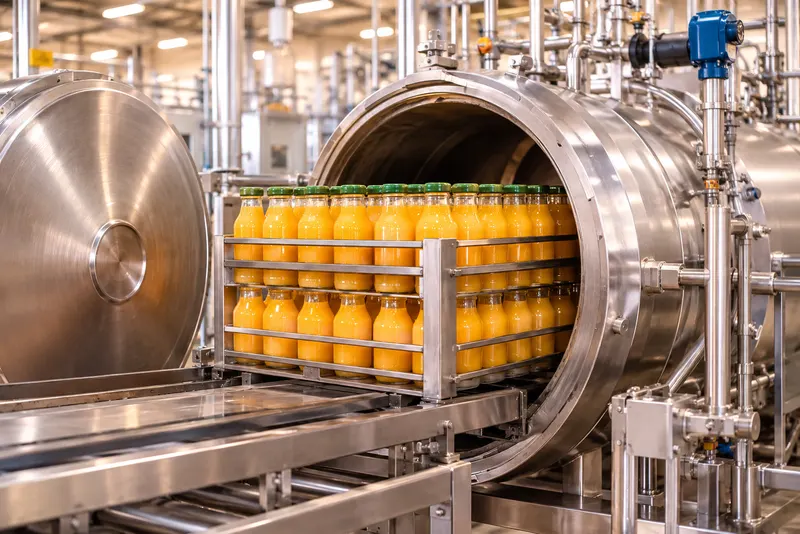
Row of cup-type citrus juice extractors fed with whole oranges

Industry 01

Citrus processing: NFC juice and FCOJ concentrate

From orchards in the Souss and Gharb to the aseptic drum: we support citrus crushing plants across the whole chain, from feasibility study to day-to-day performance.

Morocco is a major citrus producer, and a growing share of fruit that does not meet fresh-market grades goes to processing. A well-designed juice plant turns that volume into value: NFC (not-from-concentrate) juice for premium markets, FCOJ concentrate for export and reconstitution, essential oils, pulp and cells, and peel for animal feed or pectin.

Profitability comes down to a few levers: extraction yield, control of bitterness and pulp, steam use at the evaporator, aseptic quality and season length. That is where our field experience is concentrated.

Key process steps

  1. 01

    Receiving and storage

    Weighing, lot sampling (Brix, acidity, Brix/acid ratio, juice yield), short storage in fruit bins or silos.

  2. 02

    Washing, sorting and sizing

    Brushing and washing, removal of damaged fruit, then sizing on a drum grader: fruit of an even size keeps the cup extractors stable and the juice yield steady.

  3. 03

    Cup extraction

    Each extractor carries five pairs of cups that interlock around the whole fruit. Juice flows through a strainer tube to the finishers; peel, albedo and seeds leave separately for valorisation (animal feed, pectin, fibre). Up to about 600 fruits per minute per machine.

  4. 04

    Essential oil recovery

    During extraction, a water spray rinses the peel: the oil-water emulsion is screened, then separated and polished by centrifuge. The water is recycled to the spray.

  5. 05

    Finishing

    Finishers remove pulp, membranes and seeds; their setting decides pulp content and yield. Pulp cells can be recovered and sold.

  6. 06

    Centrifuging and debittering

    Suspended pulp brought down to about 1%, then, when needed, resin adsorption to lower limonin and naringin.

  7. 07

    De-aeration and pasteurisation

    Removing dissolved air, then heat treatment to stabilise the juice and inactivate pectin methylesterase without damaging aroma.

  8. 08

    Evaporation (FCOJ)

    Multi-effect falling-film or TASTE evaporator, very short residence time, aroma recovery, concentration up to 65 °Brix.

  9. 09

    Blending

    Blending lots to meet the customer spec for Brix, acidity, colour and pulp; adding pulp cells back when required.

  10. 10

    Filling and storage

    NFC in chilled aseptic tanks; concentrate sterilised, cooled and filled into aseptic bags (ambient storage) or 200–250 kg drums frozen at -18 °C. CIP cleaning of the whole line.

Cup extraction heads, essential-oil spray manifold and juice collector

The challenges we see

  • Extraction yield below the fruit's potential
  • Short seasons: the plant has to be ready and reliable from day one
  • High energy and water use at the evaporator and during cleaning
  • Export buyer requirements: FSSC 22000, BRCGS, IFS, AIJN code

How we help

  • Feasibility study and plant sizing (capacity, NFC or FCOJ, by-products)
  • Specifications, supplier selection and installation follow-up
  • Commissioning, extractor tuning and team training
  • HACCP plans, certification readiness and supplier audits
  • Tracking yield, OEE and cost per tonne of fruit

Standards and frameworks

  • Moroccan law 28-07 and ONSSA approval
  • HACCP / Codex Alimentarius
  • ISO 22000 / FSSC 22000
  • BRCGS, IFS Food
  • AIJN Code of Practice

Read next

Aseptic orange juice: the technologies from orchard to bottle

Orange juice that is shelf-stable, preservative-free and still tastes of fruit: that is what the aseptic chain is for. Step by step, what has changed from the orchard to the cap.

Read the article

Orange juice: the technologies changing processing in 2026

From extractor to aseptic drum, the orange juice line has moved on a lot. An overview of the technologies that really matter for a Moroccan plant.

Read the article

HPP, PEF, UV-C: non-thermal treatments for NFC juice

Demand for 'freshly squeezed' taste is driving non-thermal treatments. What they really deliver, and what they demand of the plant and the distribution chain.

Read the article

A project in this industry?

The first consultation is free. Tell us about your plant or project and we will get back to you within 48 hours.