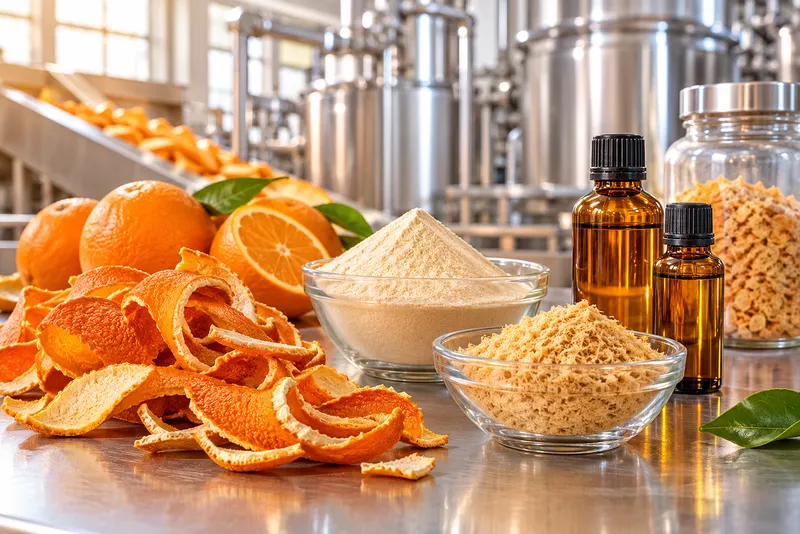
Citrus by-products: from peel to added value
Roughly half the fruit never ends up in the juice. Well used, peel, pulp and oils can change the economics of a plant.
Read the article → Lakhdar Consulting

Industry 06
A feed mill turns variable raw materials into a consistent product at the lowest cost. We help make both the plant and the quality reliable.
Compound feeds for poultry, cattle and sheep are made from cereals, oilseed meals, minerals and additives. Food-industry by-products (citrus and beet pulp, bran, spent grains) find a valuable outlet here.
Dosing accuracy, mix uniformity and pellet quality make the difference, as does control of cross-contamination and salmonella.
Raw material checks, silos and storage bins.
Hammer mills, particle size chosen for the species.
Automated weighing, premixes, liquid addition.
Steam conditioner, pellet press, cooler, crumbler.
Fat and enzyme addition after pelleting.
Packing, loading and traceability.

The first consultation is free. Tell us about your plant or project and we will get back to you within 48 hours.